On-call Crisis
At your service 24/7
What happened?
On September 6, 2026, state-level elections were held in the state of Saxony-Anhalt. Saxony-Anhalt is one of Germany’s 16 federal states and one of the five eastern German states. With a population of just 2.1 million (Germany: 84 million) and 1.7 million eligible voters, the state is one of the smallest in the Federal Republic. Nevertheless, the election received an exceptionally high level of attention, including internationally. This is due to the landslide victory of the AfD (Alternative for Germany); the AfD’s state chapter in Saxony-Anhalt is classified by the Office for the Protection of the Constitution as “confirmed far-right.”
The (preliminary official) election result
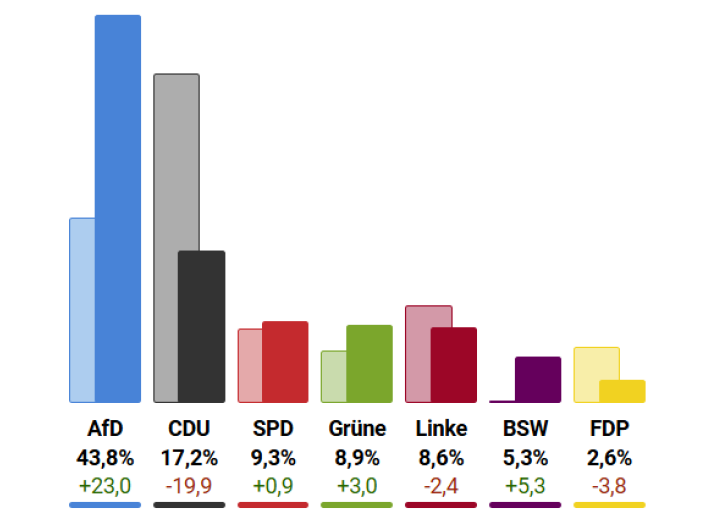
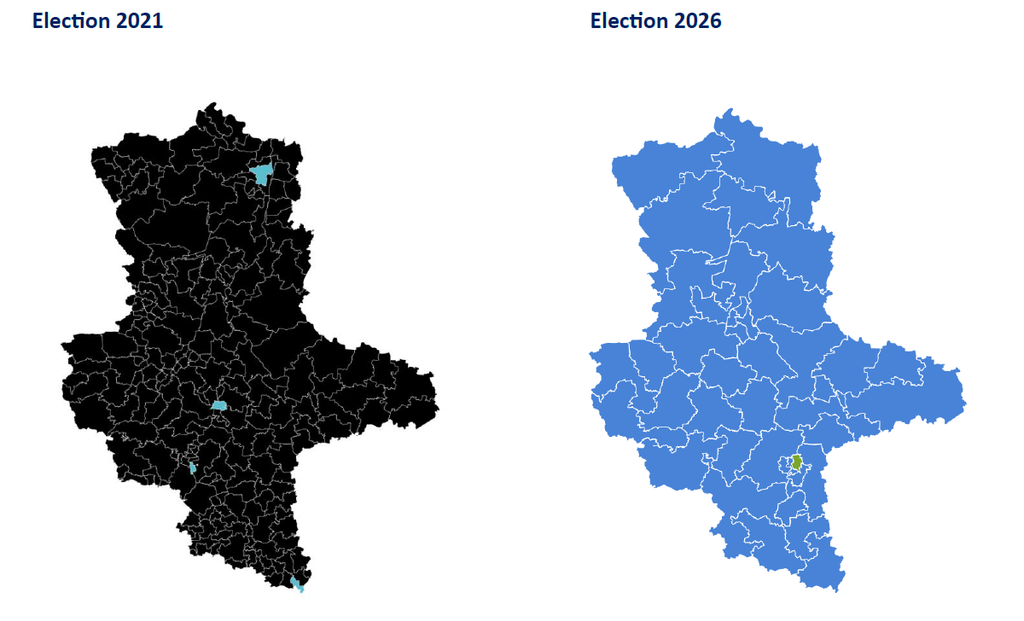
The AfD’s landslide victory can also be impressively illustrated graphically using the votes cast for the parties. A comparison with the last state elections in 2021 shows the shift in majorities in the electoral districts of Saxony-Anhalt (blue = AfD, black = CDU, green = Greens):
Possible government constellations
As is so often the case, the election results are inconclusive and make forming a government highly complicated. At least the results prevent the AfD (39 seats) from securing an absolute majority (42 seats). Before the election, an absolute majority had been a realistic possibility if several parties—such as the BSW, the Greens, and the SPD—had failed to clear the 5% threshold. As it stands, however, the AfD is three seats short of an absolute majority.
With the exception of the far-left BSW, all other parties have categorically ruled out a coalition with the far-right AfD. It seems surprising that a far-right party could join forces with a far-left party in a governing coalition (44 seats). In fact, the two parties have a surprisingly large number of overlapping issues, such as their political proximity to Russia, their aversion to NATO, their skepticism toward climate protection and renewable energy, as well as their shared rejection of the EU and the euro. A minority government led by the AfD and tolerated by the BSW would also be conceivable.
Without the BSW, the other parties are unable to secure a majority of seats in the state parliament. Even an alliance of the four parties, the CDU, SPD, Greens, and Left Party, would not have a majority (39 seats). The four parties would have to form a coalition with the BSW or rely on its support. However, such a governing coalition would be extremely difficult to organize, as the parties’ political views and values are virtually incompatible. Nevertheless, incumbent Minister-President Sven Schulze (CDU) will (have to) do everything he can to enter into negotiations with the parties.
What are the key lessons learnt from the election?
One of the smallest federal states in terms of the number of eligible voters is sending shockwaves through Germany, even though many things remain completely unclear the day after the election. Perhaps the most important insights are the following :
A far-right party is establishing itself at the state level.
The AfD’s election victory opens a new chapter in the history of the Federal Republic. Even though the AfD narrowly missed securing an absolute majority in Saxony-Anhalt, its landslide victory sends a more than clear warning signal to all federal states’ governments and the federal government. With an exceptionally high voter turnout of 78 percent, more than 43 percent of voters chose a party classified as “confirmed far-right,” largely motivated by a desire to show the established ‘old’ parties that their policies have failed.
With this democratic mandate, the AfD derives a mandate to govern from the fact that it is the strongest party. However, no such mandate exists in the political system of the Federal Republic of Germany. The party that can organize a majority will form and lead the government. The AfD will now attempt to organize such a majority as the other parties will. From today’s perspective, it is still completely unclear who will ultimately form a government in Saxony-Anhalt and as part of which governing coalition. An AfD-led government with an AfD minister-president may seem unlikely at the moment, but it is certainly possible.
The far-left BSW becomes the kingmaker
The BSW is celebrating its narrow entry into the state parliament. The BSW, led by party founder Sahra Wagenknecht and believed to be on its last legs before the election, managed—by a margin of just a few hundred votes—to become the kingmaker for either the far-right AfD or the other parties. A potential “nightmare scenario” involving far-right and far-left forces in a government coalition suddenly seems possible.
The CDU is running into rough waters – and its Chancellor along with it
If the CDU loses a state election, it always has repercussions for federal politics, especially when the Chancellor is a member of the CDU and also serves as the party’s chairman. Even if there is no direct impact on federal politics, the federal party, or the federal government, the CDU will not be able to move on to business as usual without consequences.
As CDU party chairman, incumbent Chancellor Friedrich Merz will be held largely responsible for the halving of the party’s vote share in Saxony-Anhalt. The unpopular Chancellor, who is also navigating rough waters politically at the federal level, will be in full defense mode in the coming days and weeks. While it is unlikely that he will fail as Chancellor alongside the federal government, a dramatic sharpening of the CDU’s political profile is necessary, especially since Merz took office promising to halve the AfD’s vote share in Germany. Already, the first calls for personnel changes are being heard within the party. The Bavarian sister party, the CSU, is also demanding that the CDU party finally take a clear political stand.
The established parties are becoming paralyzed
Whether it’s the CDU, SPD, Greens, or Left Party: the established parties are currently no longer capable of credibly addressing Germany’s problems. Over the years, the ‘old’ parties have made themselves vulnerable to extreme forces and charismatic populists. This situation is not likely to change in the foreseeable future.
The impact on the economy
In its election manifesto, the AfD promises to halt the “economic decline” in the structurally weak state of Saxony-Anhalt. However, all economists in Germany agree that an AfD-led state government could hardly change anything, because responsibility for many of the policy ideas in the AfD’s party program does not lie at the state level at all.
However, it is considered certain that demographic trends would take a dramatic turn for the worse for the economy. Out of fear of the AfD, many people with an immigrant background are already considering leaving the state. Others will avoid moving to the state in the future, thereby exacerbating the severe shortage of skilled workers. Investments would also be at stake. Deutsche Bank CEO Christian Sewing stated, “International investors’ view of Germany will definitely become more negative. Many announced investments will, at the very least, be called into question. Investors will ask themselves what this means for Germany’s long-term policies, long-term stability, and reliability.”
What’s to come
The coming days will send many in Berlin’s political circles into crisis mode. But the next political challenges are already looming on the horizon, as the next two state elections are scheduled for September 20.
In the eastern German state of Mecklenburg-Western Pomerania, too, the AfD is currently in the lead. Here, however, the situation is somewhat different than in Saxony-Anhalt, as the ruling SPD trails the AfD by only a few percentage points. This could make forming a government less complicated, even if the AfD emerges from the elections as the strongest party. The CDU currently stands at less than 10% in the polls.
Elections will also be held in the federal state of Berlin on the same day. The ruling CDU could emerge as the big loser here, possibly even being overtaken by the AfD. A future governing coalition consisting of the SPD, the Greens, and The Left is likely here. The loss of the incumbent mayor, combined with a poor showing by the CDU in Mecklenburg-Western Pomerania, would enormously increase the pressure on the CDU and Chancellor Merz within a matter of days.